Tuesday, September 27, 2011

Chamber After Hours- Wed 9/28


  Come visit us at the Tree Farm tomorrow night (Wednesday, September 28th) from 5-7 pm. Burgers, drinks (both beer flavored and cider flavored), ride the rides (the mini-excavator) and use the medieval battle thing (trebuchet)!! It'll be fun. It's a debut of our outdoor kitchen and a chance to wander among our trees. See you there!

Thursday, September 1, 2011

The time to plant trees....

More from Mike at the tree farm:
Ooops....due to all of our expansion, I lost quite a bit of production area and have over 400 five gallon trees to line out this fall. These trees are NOT "plant it and forget it" kind of trees. These are much younger, smaller trees that will need annual pruning for 3-4 years in order to develop a strong leader and dense canopy. They may even need a stake to keep them straight. Don't worry though.... we have care sheets available. And if you have questions, you can call or stop by the farm! Varieties include:
-Bald Cypress
-Crabapples:
  Royal Gem, Royal Raindrops, Sargentina, Sargent, Spring Snow
-Maples:
Autumn Fantasy, October Glory, Oregon Trail Sugar, Red Sunset
-Swamp White Oak
-Cleveland Select Oak

Notes from Laurel, the designer: A great way to use these little trees is on large acreage. If you've been waiting to plant that windbreak but need to save money, this is the ticket. As Mike says, you must be willing to do the work to get a well formed tree! But at $30 a pop, these are a bargain. So think mass planting (like a north windbreak) OR do something dramatic and think English country manor and plant "pleached" trees on the front of your property. That is a fancy word to describe trees that have been pruned up to create an open area at the bottom but the upper branches grow together to provide privacy on top. It still feels airy but offers a green privacy fence! (doesn't work for the dogs of course :)) Pleaching has a long and labor-intensive history, but you can do an American version by planting these young trees, with stakes together to form a barrier. Ask us if you have questions!


Tuesday, August 23, 2011

Narrow Trees- from the Tree Farm

Need shade for a narrow area? We have the solution! Choose a tree with a narrow canopy- this will allow cars, people, etc to move underneath with very little issue. From a design standpoint, these narrow trees also provide a privacy block, while still allowing light and air to move through. Imagine blocking that harsh 5 o'clock sun into your house with a row of narrow, upright trees?

photo courtesy of oregonstate.edu

-Armstrong Maple is a fast growing tree that will reach 45' tall with a spread of only 15'.  Fall color varies from yellow to orange-red. This is one tough, durable tree- often chosen as a street tree where space demands a tree that doesn't spread!


-Cleveland Select Pear is also a tall, narrow tree that is a fast grower! This tree will grow to 40' tall with a spread of 15' as well. The canopy is very dense so not only does it provide shade, but it can also be used for screening. It starts spring awash in white blossoms followed by dark green glossy leaves in teh summer that turn purplish red in the fall. These trees do not break apart as often as the Bradford Pear. I have a row planted on the north end of the pond, and in 5 years, they have yet to lose a branch!


-Musashino Zelkova is a very narrow, upright, vase-shaped tree that will reach 45' H and 15' W. The leaves are a medium green color which turn yellow in the fall. It a has a delicate, lacy canopy compared to the other two trees. We will be digging a limited number of these this fall, so you can handpick from the field! Here is a Schmidt pdf about this rarely seen, very useful tree!

Monday, August 8, 2011

Japanese Maples

Many people long for just the right spot to plant a Japanese Maple. Before you rush out and buy one, there are a few things to know about the knockout.
Most Japanese Maples are burgundy but not all. Many are green (Virdis) or have green leaves, red stems (Coralbark). Most turn amazing fall colors: orange, gold, yellow, scarlet, plum, etc. As well, there are two distinct classes: acer palmatum (regular shaped maple leaves) and acer dissectum (laceleaf or a smaller, more divided leaf). Usually the laceleaf varieties stay a bit smaller.
Japanese Maples, while really maples, behave more like a Hydrangea or another shade loving tree. They are a great focal point near your house, due to their smaller scale and lovely detail, but they require at least partial shade everyday. Morning sun and afternoon shade is a perfect setup for these beauties! Protection from the elements is essential as well. Early spring frosts and winds from the south can really hurt these trees but plant them close to the house, in a protected noon and you'll be pleased at the results.

Mike at the tree farm has this to say:
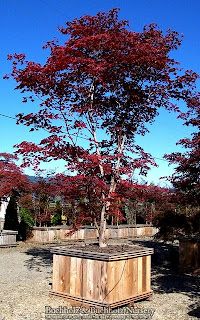
Image courtesy of Bucholz Nursery
Bloodgood is the standard of the purple leaved tree form Japanese Maples. They will eventually grow to be 18' high and wide. The foliage comes out reddish purple and hold the color well until a heat wave hits! The color will then get a bit more green but go back to red as soon as the cool weather comes back.
Emperor I is very similar to the Bloodgood in shape, height and width. However, it holds its color better in hot weather and leaves out a bit later than the Bloodgood. Thus avoiding those late freezes that can kill a tender Japanese Maple. 
Tameukeyama is one of the best weeping lace-leaf varieties for our area. The leaves hold their deep purple color through the heat. They stay small, usually hitting 8' H x 12' W at maturity.

Mike's Site Selection advice: Drainage is key to the happiness of these trees. They don't like wet feet so make sure water doesn't stand in the area you've chosen.  When you plant your tree, make sure the root ball is2-3" above grade. (In other words, find the root flare- where the trunk connects to the root- and don't bury that). Slope the soil up to the root ball- this way water will not pool around the plant and you won't be burying your tree in mulch. Always keep in mind the final mature size (especially with Bloodgoods and that type)- you cannot prune these forever and keep them 6' tall. They want to grow- plant them where their mature size will be an asset!

Here is a cool site that explains about finding the root flare! Also, if you love to look at the ever-expanding world of Japanese Maples, go to the Bucholz Nursery library online.

Tuesday, August 2, 2011

News from the tree farm... We're in maintenance mode now!


The combination of hot days and warm nights really doesn't allow plants any time to recover from the scorching heat. We are attempting to put out the fires (metaphorically) by running the field irrigation (even on trees that have been in the ground for 3 years)!
Mike says: "Don't forget about the trees in your yard. Even if you have an irrigation system, it is not enough water! Larger trees may not show any signs of stress until next year." Check the soil around your trees and shrubs by putting your finger or a rod into the ground about 1 1/2" down. If it is dry, give it a long slow drink- this means 30 minutes to 1 hour on drip directly to the root system of the tree. (The larger the tree, the longer you water. 30 minutes is good for most shrubs.)


Pink Velour Crape Myrtle, loving the heat. That makes one of us.


On the positive side, this heat is really making the crape myrtles happy! We carry Tonto (deep red) and Pink Velour. They love the heat! Keep an eye out around town for neighborhood crape myrtles.

Thursday, July 28, 2011

Need a cool splash in your yard? Try a water feature!


Pondless waterfalls are the latest design trend in low maintenance water features.  Their appeal is having the visual and audible benefit of a water feature without the laborious maintenance of a pool that attracts algae, wildlife, and insects.  A pondless water feature also has the benefit of allowing small children and pets to interact with the water without the fear of falling into an open pool.


The key component of the pondless water feature is to have the pump draw its water from an underground cistern-style reservoir, rather than an open air pond.  The water that runs down the fall percolates through layers of decorative rock where it is drawn into the pump.
At Lawrence Landscape, we have taken the pondless water feature design to the next level by incorporating them into retaining walls.  By doing this, we now provide our clients with all the benefits of running water while minimizing the required space that many natural stream bed designs require.  The other challenge with natural stream beds is that most look like volcanoes that all of a sudden appear in the corner of someone’s back yard. With our approach, the water feature co-exists with a natural retaining wall that is needed to define the outdoor space or create a screen of nearby structures.
We have also developed our mechanical system to utilize tried and true off-the shelf components, while keeping them completely out of site.  This has greatly reduced the need for follow-up repairs and replacements. 


 To continue pushing the design envelope, we have started design drawings that will allow clients to have fire and water features in outdoor living spaces that have restricted space for traditional methods.

Bagworms!! It could happen to you...

            If you don’t have them know, then there is a good chance that you’ve seen them before.  It is the worm that lives in a sack.  It seems to eat just about anything.  It looks like an ugly, brown Christmas tree ornament.  It is the infamous bagworm.


 In mid-May, the bags start to become visible.  This is when the tiny worms begin to feed.  As the worm grows, so does the bag.  Feeding will usually cease in mid-August.  Even after feeding has finished, bags likely will remain on the host plant.   
  Bagworms are most commonly known for attacking cedar and junipers.  However this pest has shown to not be a picky eater.  Over the past few years, I have seen them attached to sycamores, locust, river birch, maple, white pines, oak, cotoneaster, spruce, roses, ornamental grasses, and pears to name few.  It is easy to see that a large portion of your landscape may be at risk.  Evergreens should be monitored more often, as they have a tougher time recovering from severe injury. 

Controlling bagworms can be as simple as plucking a couple bags or may entail hiring a professional for those hard to reach spaces.  Either way it is important thorough control is achieved as missing one bag could lead to a thousand more the next year.  Lawrence Landscape does indeed offer spraying services.